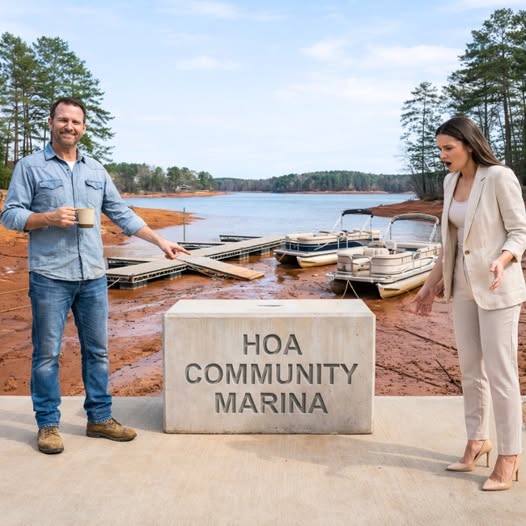
I turned and saw Beverly Drummond coming down the access path in a cream linen blazer, as if it were perfectly natural to arrive at seven in the morning dressed like a county politician attending a ribbon-cutting. She walked with that upright, deliberate posture of a person who thought the world arranged itself best when everyone else obeyed her. Her silver hair was perfectly set. Her lipstick was too bright for dawn. She wore a smile I had seen before: not warm, not friendly, but polished and practiced, the smile of someone who liked arriving after the damage was done.
“Good morning, Prescott,” she said.
I looked from her to the slab, then back again.
“The community appreciates your patience.”
I let that sit between us.
Then I said, “Enjoy it while there’s still water in it.”
Her smile thinned a fraction, but she did not answer. Beverly had been president of the Clearwater Ridge Homeowners Association for eleven straight years, and power had calcified inside her so completely that contradiction no longer seemed real to her. She stood there in her blazer with the concrete steaming behind her like a monument to her certainty, and for a moment all I could hear was the ticking engine of a truck at the top of the slope and the faint lapping of water against the poured edge.
That was the morning the fight became visible.
But the story began long before that.
It began in 1962.
My grandfather, Rutherford “Rudy” Callaway, was a millwright from western Tennessee. He had worked thirty-two years in a paper mill, the kind of job that took your hearing first, then your knees, then the softness out of your hands. He and my grandmother raised six children on wages that were never generous. He saved money the way other men prayed: methodically, stubbornly, with a faith that would have looked like foolishness to anyone less patient.
In the summer of 1962, he bought twelve acres on the eastern shore of Lake Prescott in central Georgia.
Back then, you could still buy land like that for what a used truck cost, if you were willing to live without luxuries and if you had spent most of your adult life turning overtime into savings. The land was pine-heavy and sloped sharply toward the water. The soil was red clay that stained your boots and stayed under your nails. There was no subdivision then, no HOA, no matching mailboxes, no committee with opinions about acceptable deck colors.
There was just shoreline, woods, birdsong, and water.
My grandfather built the cabin with his own hands.
He poured the porch himself. He hung the tin roof. He framed the walls straight enough that they were still standing six decades later with only minor correction. He installed a wood stove that smelled like cedar and pine resin every winter. The first dock was rough and practical, built for function rather than beauty, and he tied off a johnboat there and fished that lake until he was seventy-eight years old.
When he died, the property passed to my father, Dale Callaway.
When Dale’s knees gave out and the cold months got harder on him, he passed it to me.
My name is Prescott Callaway. My grandfather named me after the lake, which tells you nearly everything you need to know about the kind of sentimental man he was beneath all the rough edges.
But the cabin itself was only part of what he bought.
The deed mattered more.
That deed did not merely convey twelve acres of woodland and shoreline. It expressly conveyed riparian rights—the legal rights to use and control the water adjacent to the land—and more importantly, it included ownership of the lake bed to the center line of Lake Prescott along our shore, all 340 feet of it. My grandfather’s lawyer, a meticulous old man named Harlan Fitch, had written the thing with paranoid precision.
Rudy did not trust banks.
He trusted government even less.
And he absolutely did not trust neighbors.
As it turned out, that made him the smartest man in the county.
The Clearwater Ridge HOA did not exist when Rudy bought the place.
It came later, in 1988, when a developer named Garrett Whitmore bought the western hillside across the lake, carved it into sixty-four lots, built a neat row of vinyl-sided houses with decorative shutters and identical mailboxes, and wrapped the whole thing in covenants. Those covenants gave the HOA authority over the subdivision—its lawns, its paint colors, its fences, its holiday decorations, its dues, its grudges.
Not my property.
Never my property.
Our land was outside the subdivision, never annexed, never subjected to the covenants, never folded into their little private kingdom. In legal language, we were a non-member parcel.
That phrase would eventually become the backbone of everything.
But Beverly Drummond had never liked limitations, especially legal ones.
I first crossed paths with her three years earlier, after my divorce, when I started spending more weekends at the cabin. I was repairing the dock that summer, replacing warped boards, hammering in new cleats, trying to make the place feel inhabited again. It was late afternoon, hot enough that sweat stung my eyes. I had a cold SweetWater 420 in one hand and a wrench in the other when Beverly appeared at the edge of my property like she had materialized out of the heat itself.
She wore cream linen then too.
I should have recognized the warning.
“Mr. Callaway,” she said, looking at my johnboat tied to the dock. “You’ll need to register your watercraft with the HOA Marina Committee.”
I remember staring at her, beer in hand, trying to figure out whether she was joking.
“I’m not in the HOA,” I said.
She blinked once, very slowly, as if the sentence had failed some internal plausibility test.
“Everyone on this lake is subject to the HOA marina rules.”
I set down the wrench, wiped my hands on my jeans, and pointed toward the cabin where a copy of my deed sat in the desk drawer.
“No,” I said. “Everyone on your side of the lake might be. I’m not.”
The look she gave me was fascinating. It was not anger, not at first. It was offense. The kind a person feels when reality refuses to cooperate with what they have already decided to be true.
Two days later, I got a formal violation notice in the mail.
Unauthorized dock usage. Fine: $200.
I did not pay it.
A second notice came a week later.
I did not pay that one either.
Instead, I mailed Beverly a copy of the deed with the relevant language highlighted in yellow and a letter explaining, as politely as I could manage, that I was not subject to Clearwater Ridge regulations and never had been.
She did not take that well.
I later learned the HOA board spent three hours in closed discussion at its next meeting on an agenda item titled Callaway Parcel Long-Term Strategy.
That should have been my warning.
The first escalation was bureaucratic, which suited Beverly perfectly. She liked pressure that came dressed as procedure. She liked envelopes with official stamps, meetings scheduled on weekdays, letters that made ordinary people feel tired before they even opened them. Six months after the marina fine nonsense, I received a certified letter from the county zoning office.
A formal complaint had been filed alleging that my dock encroached on community waterway access and required review.
The complaint was anonymous, but in a county where I had no enemies except one HOA president in a linen blazer, mystery was not really part of it.
I had to take a Tuesday off work and drive two hours to the county seat.
The office smelled like copier toner, old carpet, and the peculiar despair of local administration. A zoning officer named Gary took my paperwork, looked at my deed, looked at the complaint, and then looked at my deed again with the blank patience of a man who had been waiting for retirement for most of a decade.
“Complaint dismissed,” he said finally. “Your rights are clear.”
That was it.
Forty-five minutes. Four hours of driving. A tank of gas. One vacation day burned.
I went home irritated but relieved. That evening I grilled catfish on the porch, watched the light fade over the water, and told myself Beverly had probably taken her shot and missed. Most people like that relied on one bureaucratic weapon. Once it failed, they moved on to easier targets.
Beverly Drummond, I learned, did not believe in using one bullet when she could empty the magazine.
The next move came under a prettier name.
The HOA created something called the Lake Prescott Waterway Beautification Initiative.
Its stated purpose was to improve the aesthetic and navigational quality of the lake for the community. Its actual purpose was to create a mechanism through which Beverly could harass anyone she disliked under the banner of beautification.
Within two weeks, I received a notice from the HOA informing me that my dock was aesthetically non-compliant, my johnboat was an eyesore inconsistent with community standards, and I had thirty days to either upgrade everything to HOA specifications or remove it entirely.
The attached specifications were absurd.
All docks had to be composite decking in one of three approved colors. All watercraft had to be registered. All lake users had to pay an annual stewardship fee of $450 to the HOA.
None of it applied to me.
Not one word.
But by then I had begun to understand Beverly’s strategy. She was not trying to win on legal grounds. She was trying to exhaust me. Notices, letters, complaints, fees, meetings, the low endless friction of being targeted by people who hoped inconvenience alone would make resistance feel expensive.
So I wrote back.
This time, I made the language sharper.
I am not a member of the Clearwater Ridge HOA. I am not subject to HOA regulations or fee schedules. Please direct future correspondence of this nature to my attorney.
At that point I did not yet have an attorney.
But that sentence changes the weather in a conflict.
Beverly went quiet for about six weeks.
I thought perhaps the temperature had finally become uncomfortable enough for her to back off.
Then one Thursday evening, my neighbor Thaddeus Burke called.
Thad lived two lots down, a retired railroad engineer with a square jaw, careful speech, and the sort of practical intelligence that does not announce itself. We had become friendly over the years in the casual way lake neighbors do—shared tackle, borrowed ladders, weather talk, fence-line conversations. He was not a man given to drama.
See more on the next page
Which is why, when he said, “Prescott, you need to come down to the lake,” I set my coffee down immediately.