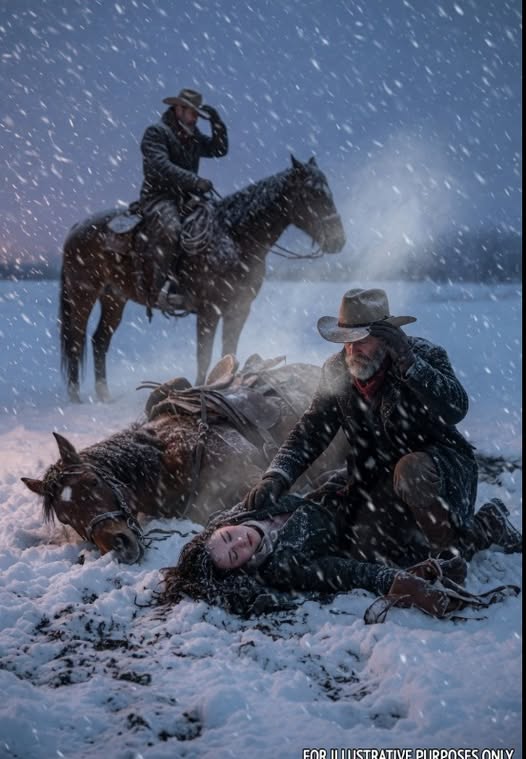
The ground was cruel, iron-hard beneath the drift. His fingers, already wrapped in linen from frostbite, opened twice and bled into the handle of the spade. He kept on. A horse that carried a woman as far as it could deserved better than coyotes and weather.
By the time he finished, the sun had lowered behind the pines, making the snow shine blue in the hollows. Luke marked the place with three stones and the mare’s broken bridle, then carried the saddlebag back to the cabin.
Inside, warmth met him with the smell of coffee, damp wool, pine smoke, and cornmeal frying thin in the pan. Eli sat upright beneath the quilt, pale but alive. Clara Weston was propped near the hearth, wrapped in Luke’s blanket, her dark hair braided loosely over one shoulder. She looked smaller awake than she had unconscious, yet there was a steadiness in her eyes that did not belong to someone accustomed to being helpless.
She saw the saddlebag before she saw his face.
“You found it,” she said.
Luke closed the door with his shoulder. “Yes, ma’am.”
Her hand moved toward the bag, then stopped halfway. Her fingers trembled. Not from cold this time.
“Did you read the letter?”
“No.”
“The draft?”
“Saw enough to know it was not mine.”
Clara looked down at the quilt covering her knees. The firelight touched her face and showed Luke what the snow had hidden: exhaustion older than one storm.
“I owe you the truth,” she said.
Luke set the saddlebag on the table. “You owe me rest. Truth can wait until you are stronger.”
“No.” Her voice was soft, but it held. “It has waited too long already.”
Eli looked between them, wide-eyed and silent, a half-eaten Johnny cake in his hand.
Clara drew the oilcloth packet from the bag and held it in her lap as though it weighed more than iron. “My name is Clara Weston Hayes.”
Luke said nothing.
Most men in Montana Territory knew the Hayes name, even if they had never crossed the threshold of a Hayes barn. Cattle from that brand moved across half the Territory. Their wagons supplied line camps. Their contracts fed soldiers, railroad crews, and mining outfits. William Hayes had built the company, folks said, but his widow had made it feared.
Luke had heard men in Copper Ridge speak of her with the sour respect men saved for a woman they could not cheat.
“You own Hayes Cattle,” he said at last.
“I do.”
Eli’s eyes grew round. “Like… all of it?”
A faint smile crossed Clara’s mouth. “Enough of it to keep me tired.”
Luke remained by the door, hat still in his hand. The distance between the hearth and the threshold had not changed, but something in the room had. The woman wrapped in his poor blanket was not merely a frozen traveler. She was an owner of land, cattle, contracts, debts, enemies, and a life that stood so far above his that looking at it too long felt foolish.
“Why were you alone on Widow’s Pass?” he asked.
Clara’s hand tightened on the packet. “Because I was angry. And because I was proud. Those two habits nearly killed me.”
She told it without ornament. She had ridden from Helena after a meeting with bankers and cattle buyers, men who smiled over polished tables while trying to take pieces of what her husband had left and what she had doubled by her own judgment. One man in particular, Silas Trent, had offered to purchase a controlling share of Hayes Cattle under the language of rescue.
“He said a widow’s hand was too sentimental for a hard market,” Clara said. “He said the Territory would forgive me for selling before I embarrassed my husband’s name.”
Luke’s jaw tightened.
Clara watched the flame. “When I refused, he bowed as if he had only paid me a compliment. Then he said, ‘Mrs. Hayes, dignity is most useful when it knows when to retire.’”
Eli frowned. “That was mean.”
“Yes,” Clara said. “It was.”
She had left Helena before dawn, intending to reach Three Forks before weather turned. The sky had looked clean. Her mare had been strong. Her pride had been louder than caution. By afternoon, the storm took the trail. By evening, the mare went down.
“I remember falling,” she said. “Then crawling. Then thinking how strange it was that a woman could spend years fighting men across desks and ledgers, only to be beaten by snow.”
Luke moved to the stove and poured coffee into a tin cup. He handed it to her without speech.
She accepted it with both hands. Their fingers did not touch, but she looked at his bandaged knuckles.
“You buried her?”
“Yes, ma’am.”
Clara closed her eyes. “Thank you.”
It was the way she said it that unsettled him. Not grand, not practiced, not like a rich woman thanking a hired hand. Just two words, laid bare.
For three days the snow held them prisoner.
Luke cut a path from the door to the woodpile, then from the cabin to the small shed where he kept tack, beans, and tools. Eli recovered quicker than Luke did, as children sometimes do, though he stayed close to the hearth and closer to Clara. He asked her questions with no manners polished enough to hide them.
“Do rich people eat Johnny cakes?”
“When someone kind makes them, yes.”
“Do you have dogs?”
“Four at the main ranch.”
“Can one of them be mine?”
Luke looked up sharply. “Eli.”
But Clara only smiled into her coffee. “A dog ought to choose his boy, not be assigned like a chore.”
Eli considered that solemnly. “Then I will let him choose me.”
On the second night, after Eli slept and the wind worried the chinks between the logs, Clara asked Luke about the woman whose name the boy had murmured in dreams.
Luke took longer to answer than politeness required.
“Sarah,” he said at last. “My wife.”
Clara folded her hands around the cup in her lap. “How long?”
“Three years come May.”
“I am sorry.”
He nodded once. Men in the Territory said that phrase often enough, usually in passing, usually because death was as common as dust. Clara said it like she knew where the words landed.
“Fever,” Luke said. “A neighbor rode through sleet to fetch the doctor. Lost a horse doing it. Doctor came too late.”
“But the neighbor came.”
Luke looked at her then.
“Yes.”
“And that is why you stopped for me.”
The fire shifted. A coal fell and broke red in the ash.
“I suppose,” Luke said. “A man remembers who came when he had no right to expect anyone.”
Clara’s eyes shone, though no tears fell. “Most men remember what they are owed. Fewer remember what they were given.”
Luke did not know what to do with that, so he rose and added wood to the stove.
On the fourth morning, a rider appeared at the tree line.
Luke saw him first through the frost-clouded pane: a tall man on a black horse, wrapped in a fur-collared coat, with a hat too clean for common travel. He did not ride like a neighbor. He rode like someone expecting doors to open.
Clara stood despite Luke’s warning. Her face had gone still.
“Who is he?” Luke asked.
“Mr. Whitmore. My attorney.”
The man dismounted and came no farther than the porch until Luke opened the door. His eyes moved quickly over the cabin, the horse inside, the poor table, Eli by the hearth, Clara wrapped in borrowed wool. He removed his hat.
“Mrs. Hayes,” he said. “The Territory has been half mad looking for you.”
“Only half?” Clara replied.
A flicker of relief crossed his face, then vanished under manners.
He bowed slightly to Luke. “Sir.”
“Luke Carter,” Clara said before Luke could speak. “He saved my life.”
Whitmore’s gaze returned to Luke, sharper now. Not warmer exactly, but more exact.
“Then Montana owes you a debt, Mr. Carter.”
Luke stepped aside. “Coffee’s poor, but it’s hot.”
That seemed to surprise the attorney more than the rescue. He accepted the cup anyway.
Whitmore brought news with him. Silas Trent had already spread word through Helena that Clara’s disappearance proved her judgment unreliable. He had approached two board members, three bankers, and a cattle buyer with an offer to stabilize Hayes operations should tragedy require it.
“How generous of him,” Clara said.
Her voice held no heat. That made it colder.
Whitmore removed a folded telegram from his coat. “He also petitioned Judge Albright to review your late husband’s trust provisions if you are declared incapacitated.”
Luke heard the formal words before he understood them.
Clara understood at once.
“He moved before knowing whether I was dead.”
“Yes.”
Eli whispered, “That man is worse than mean.”
Clara looked at the boy. “Yes,” she said again. “He is.”
By afternoon, Luke had hitched his gelding to the small sled he used for wood hauling. Clara could not ride hard yet, and the snow still ran deep over the low road. Whitmore wished to send for a proper carriage. Clara refused. Luke said nothing. He simply packed blankets, coffee, dried venison, and the saddlebag with the H seal.
Before they left, Clara stood beside the mare’s grave.
Her gloved hand rested on the bridle half-buried in snow.
“She carried me through five years of men thinking me weak,” she said. “It seems unjust that she should fall when I finally needed her most.”
Luke stood a respectful distance away. “She did not fail you. She brought you far enough to be found.”
Clara turned her face toward him.